hashforge: Password Security Toolkit
Three Python tools behind one CLI covering the password lifecycle: entropy audit with breach-check via HIBP k-anonymity, ranked hash identification, and dictionary-attack driver over John the Ripper and Hashcat. Standard library only, no third-party crypto.
Overview
hashforge is three small Python tools behind one CLI, covering the password-handling lifecycle end to end: is this password any good, what algorithm produced this hash, and can we crack it. Standard library plus one optional dependency (requests, only used when the entropy tool hits Have I Been Pwned). Deliberately standard-library-only, because the point wasn’t to replace hashcat. It was to understand what hashcat does, and why the cracking part is the smallest part of the pipeline.
Why I built it
Mission 2 in my cybersecurity learning track. Portwalker (mission 1) taught the network layer: how a scanner sees the outside of a system. hashforge covers what happens once you have the hashes.
Password entropy, hash identification, and dictionary attacks are three different disciplines with three different textbooks. Building a tool that touches all three forces you to actually understand each one, not just recite the buzzwords. The interesting insight the project taught me: hash identification is what makes cracking possible. Hashcat needs the format flag before it can do anything. Once you can identify the algorithm, the “cracking” is a subprocess call.
The three tools
entropy, is this password any good?
Scores a password’s Shannon entropy in bits, based on length and character-set complexity. With --hibp, it also checks whether the password has appeared in a real breach. The HIBP check uses k-anonymity: only the first 5 characters of the password’s SHA-1 leave your machine, then HIBP returns every matching hash suffix and the checker completes locally. Your password never gets transmitted, only a five-hex-char prefix of its hash.
identify, what algorithm hashed this?
Given an unknown hash string, returns ranked guesses at the algorithm from prefix, length, and character-set analysis. MD5 (32 hex chars), NTLM (also 32 hex chars, byte-identical to MD5), SHA-1 (40), SHA-256 (64), bcrypt (starts with $2a$ / $2b$ / $2y$), and a few dozen more.
Ranked because a lot of hash formats are visually indistinguishable. Only context can break a tie between MD5 and NTLM. The tool ranks candidates by likelihood and lets the operator decide, instead of pretending to be certain.
crack, can we actually crack it?
A thin, friendly wrapper over John the Ripper and Hashcat. Given a hash file, crack peeks at the first hash, asks identify for the format, and drives John (or Hashcat, if you ask) with the right --format flag. Dictionary attacks by default, mask attacks via --mode mask.
The point wasn’t to write a new cracker. It was to make John’s flag ecosystem invisible when you know what you’re doing but forgot the exact incantation.
Show, don’t tell
Entropy: length actually beats complexity.
$ python hashforge.py entropy "Tr0ub4dor&3"
       length : 11
    char pool : 94
      entropy : 72.1 bits
     strength : strong

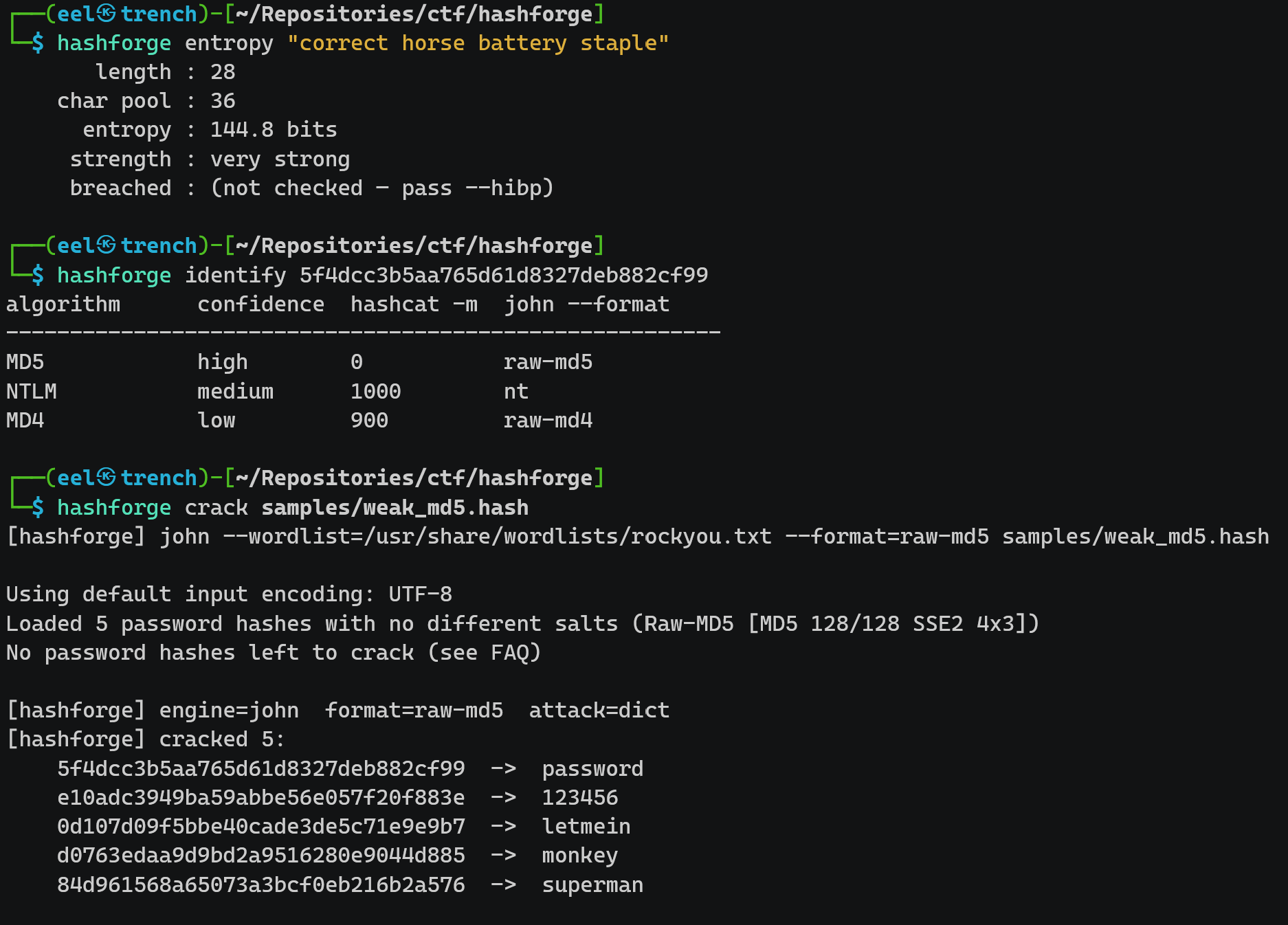
$ python hashforge.py entropy "correct horse battery staple"
       length : 28
    char pool : 36
      entropy : 144.8 bits
     strength : very strong
The xkcd result, empirically confirmed. The passphrase has twice the entropy despite using a smaller character set.
Entropy + HIBP: why the math alone lies.
$ python hashforge.py entropy "password" --hibp
       length : 8
    char pool : 26
      entropy : 37.6 bits
     strength : reasonable
     breached : YES, seen 52,372,427 times
“password” looks reasonable by the math but has appeared in real breaches 52 million times. Only 5 characters of its SHA-1 (5BAA6) left the machine to learn that.
Identify: honest about ambiguity.
$ python hashforge.py identify 5f4dcc3b5aa765d61d8327deb882cf99
algorithm      confidence  hashcat -m  john --format
--------------------------------------------------------
MD5            high        0           raw-md5
NTLM           medium      1000        nt
MD4            low         900         raw-md4
MD5 and NTLM look identical on the wire (both 32 hex chars). The tool ranks rather than lies.
Crack: auto-detects, then runs.
$ python3 hashforge.py crack samples/weak_md5.hash
[hashforge] engine=john  format=raw-md5  attack=dict
[hashforge] cracked 5:
    ?  ->  password
    ?  ->  123456
    ?  ->  letmein
    ?  ->  monkey
    ?  ->  superman
No --format given. crack peeked at the hashes, called identify, added --format=raw-md5, and drove John. The friction between “I have a hash file” and “I have plaintext passwords” is the identification step, and the tool makes it invisible.
Demo
What this taught me
- Password entropy is an upper bound, not a truth. The math assumes the attacker knows nothing about your password. In reality, common passwords are common, and entropy-based scores don’t know that. HIBP is the check that grounds theory to reality.
- k-anonymity for breach checks. You can query a database of 800+ million compromised passwords without ever sending the password itself. Send the first 5 chars of the SHA-1, receive back every matching suffix, complete the check locally. Beautiful applied cryptography, and it’s what makes the “check my password” experience safe.
- Most hash formats are shape-collisions. MD5, NTLM, MD4, and half a dozen others produce hashes that look byte-identical. Length and prefix disambiguation only get you partway; context does the rest. Cracking tools crash when you guess wrong, so the identification step is load-bearing.
- Length beats complexity. Every character you add multiplies the search space by the size of your character set. A common-word passphrase has more entropy than a random 8-character string, and it’s easier to remember.
- John and Hashcat are tools, not competitors. John’s dictionary attack against MD5 runs comfortably on CPU. Hashcat wins when you have a GPU and are attacking a slow hash (bcrypt, scrypt) at scale. Knowing which to reach for is the skill;
hashforgemakes the flag lookup automatic.
Ethical use
Audit or crack hashes only on systems you own or are explicitly authorized to test. hashforge’s HIBP integration is deliberately k-anonymous. That care has to extend to everything else you do with it.
Stack
Python 3.8 or newer, standard library, plus requests (only for the optional HIBP check). Drives John the Ripper and Hashcat as subprocesses. Tested on Kali; runs on any system with Python and the target engine installed.